Visual diaries and sketchbooks to connect & grow
Any time is a good time to draw!
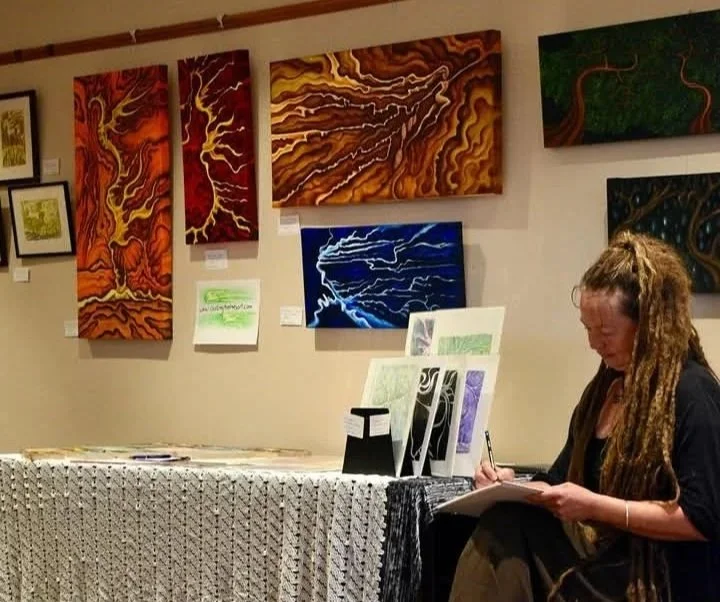
Taking a quiet moment between visitors to sketch at the Manawatu Art Showcase
As an artist, visual diaries and sketchbooks are a major part of life. I have several on the go at any one time, and piles of them spanning over two decades. I wanted to talk about them a bit as they have so many benefits, especially for your sense of connection and to grow as an artist. Even if you have no interest in being an artist (or don’t yet think of yourself as one), keeping a journal or notebook of some kind to jot down random thoughts, ideas or things that interest you can be valuable. You never know when something you noted down will be of use!
I’m a big fan of stationary, so tend to accumulate notebooks and the like. If I find one that I particularly like, it can be a bit of a challenge to actually use it instead of just looking at it and imagining what I’ll use it for! Once the first tentative drawing is made, the momentum grows.
Here, I’ll give a quick rundown of the different sizes of books I use on a daily basis, and then share the five main ways they benefit my art practice and life more generally.
Sketchbook versus visual diary
A question that often comes up concerns the difference between a sketchbook and a visual diary. The short answer is that it depends on the individual and the terms are sometimes used interchangeably. For me, the difference lies in the intent. I use my sketchbooks for drawing practice – either from life or working up concepts for paintings. Any notes in them tend to be concerned with composition/colour or similar details. I use my visual diaries more loosely. They do include drawings and sketches, but I also use them for brainstorming/mind mapping, jotting down random notes and thoughts, noting impressions of other artists’ work I’ve seen and things like that. I will also stick in pictures that catch my eye, scraps of interesting fabric, feathers – anything really that has given me an idea or that I think may give me an idea later.
Different sized sketchbooks for daily use
1. Small sketchbook (pocket size/A5): I always have a small book that I can slide into a pocket when I take the dogs for a ramble. I use it for making quick drawings when something catches my eye (mostly trees). I note down the location too, in case I need to go back with a larger book. Perfection is definitely not the idea with this book, so I give myself permission to just go for it. An inexpensive spiral bound sketchbook is great for this purpose as I’m often scrambling about places where it gets dirty or dropped, so I don’t want anything that seems fancy or “precious” as I’ll spend all my time trying to keep it clean and be too afraid to use it.
2. Larger sketchbooks and visual diaries (A4 and A3): I usually have two or three of these that I’m working in simultaneously. I use them as a combination of sketchbook and visual diary. As well as drawing from life, I use them to play around with ideas, mind map, work up concepts and make notes about composition or colour in preparatory drawings for paintings. I’ll also use these to experiment with different colours or mediums. When working up an idea, I often work from book to book, which means each iteration of a drawing evolves in response to the previous one.
3. Middle size sketchbook (A5): I have at least one book of this size lying about, which I use to take notes when I’m reading or researching. I do sometimes draw in these, but they are mostly for notes and small mind maps of thought/word associations based on what I’m reading in relation to ideas for paintings. Even though they’re mostly for writing, I like to use a spiral bound book with non-lined pages as I find lines a bit constraining for free thought.
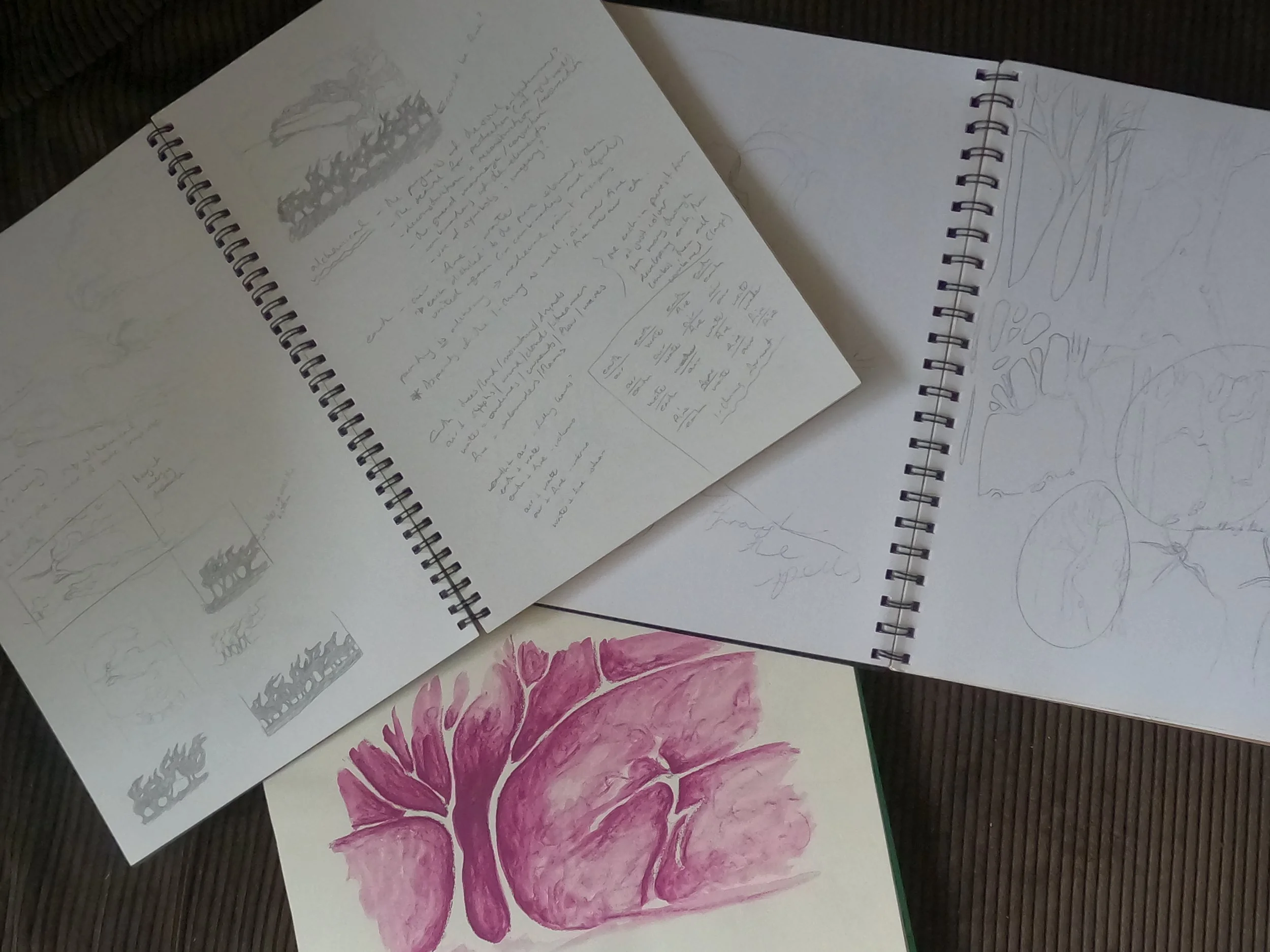
Some different uses to which I put my sketchbooks & visual diaries
Five ways sketchbooks/visual diaries can help with connection and growth
Although the ideas discussed below are set out from a personal perspective of art making, they are applicable to different creative endeavours.
#1 Connection with your surroundings
My sketchbooks (especially the pocket-size ones) are an important way for me to connect with the world around me. Walking in nature and being near trees is an essential aspect of my connection and art practice, but I find that when something catches my eye and I stop to make a drawing, I feel an even deeper connection with where I am in that moment. Maybe it’s because I’m observing in a slightly different way when drawing something. Maybe it has something to do with mood. I don’t really know the why of it, but do know how it makes me feel. It’s funny, I can walk past something many times and not really notice it particularly. Then one day it seems to jump out. I stop and make a drawing, and from then on it feels like a friend, and I give it a smile or greeting next time I’m passing. Sometimes I feel compelled to return time and time again to draw it, which makes the connection really solid (and is great for tracking improvement and style changes).
#2 Connection with the self
When I’m teasing out an idea from an initial sketch, I often use a progressive approach where I make drawings across two or more sketchbooks/visual diaries. I start with the initial sketch from life, and make a drawing from that in another book. Then I make a drawing from that drawing in a second book, followed by a drawing from that drawing in the first book etc. That means that when I reach the stage of putting something on canvas I have the original sketch and at least two versions that I can look at simultaneously, as well as easily being able to flick back to other iterations. I find this helps me maintain a connection to the original subject and to my thoughts as the image evolves. In other words, I stay self-connected and in the moment as an idea builds and grows.
#3 Growth as an artist
In terms of growth, the most obvious aspect is that daily drawing practice in a sketchbook or visual diary allows me to build technical skill and confidence, and helps me develop and refine my style. It also helps train the eye and observation skills. Regularly looking back over earlier work allows for evaluation of progress, which is an important part of growth as an artist. Sometimes you even pleasantly surprise yourself! The discipline of drawing something every day also encourages personal growth and a sense of achievement.
#4 Motherlode of ideas and material
Another major benefit of keeping sketchbooks or visual diaries is that I end up with an absolute mountain of data to mine for my art practice. When inspiration is needed, I can flick back through the collection until something sparks an idea. The same applies if you’re journaling or keeping notebooks for other purposes; you can always flick back through them when you feel at a loss or need an idea for something.
#5 Dealing with doubt
Finally, like many people, I often find ways to be negative towards myself. Regular use of a sketchbook/visual diary can help with this. As alluded to above, the discipline of making a drawing every day (no matter how insignificant or crap you may think it) establishes a sense of trust in one’s own ability to follow through, which helps build confidence and self-worth. A small pocket-sized book is also easy to keep private for jotting down thoughts to get them out of your head. If you need to, you can tear a page out and rip it up to help get rid of negative emotion, or use mind mapping to reframe something and help change your mindset about it. Idle doodling can lead to ideas, and writing down random thoughts in a kind of brain dump can help clear your mind and make room for more positive thoughts and problem solving to occur.
So in summary, if you are an artist and have not already done so, it might be time to step up your sketchbook use to develop and enhance your art practice. If you don’t consider yourself an artist or have no interest in being one, grab a book (or two) for use as a rough journal or visual diary and see where you get to.
I’d love to hear your thoughts about and adventures in this area, so comment below or drop me a note (audrey@audreyholmesart.com)